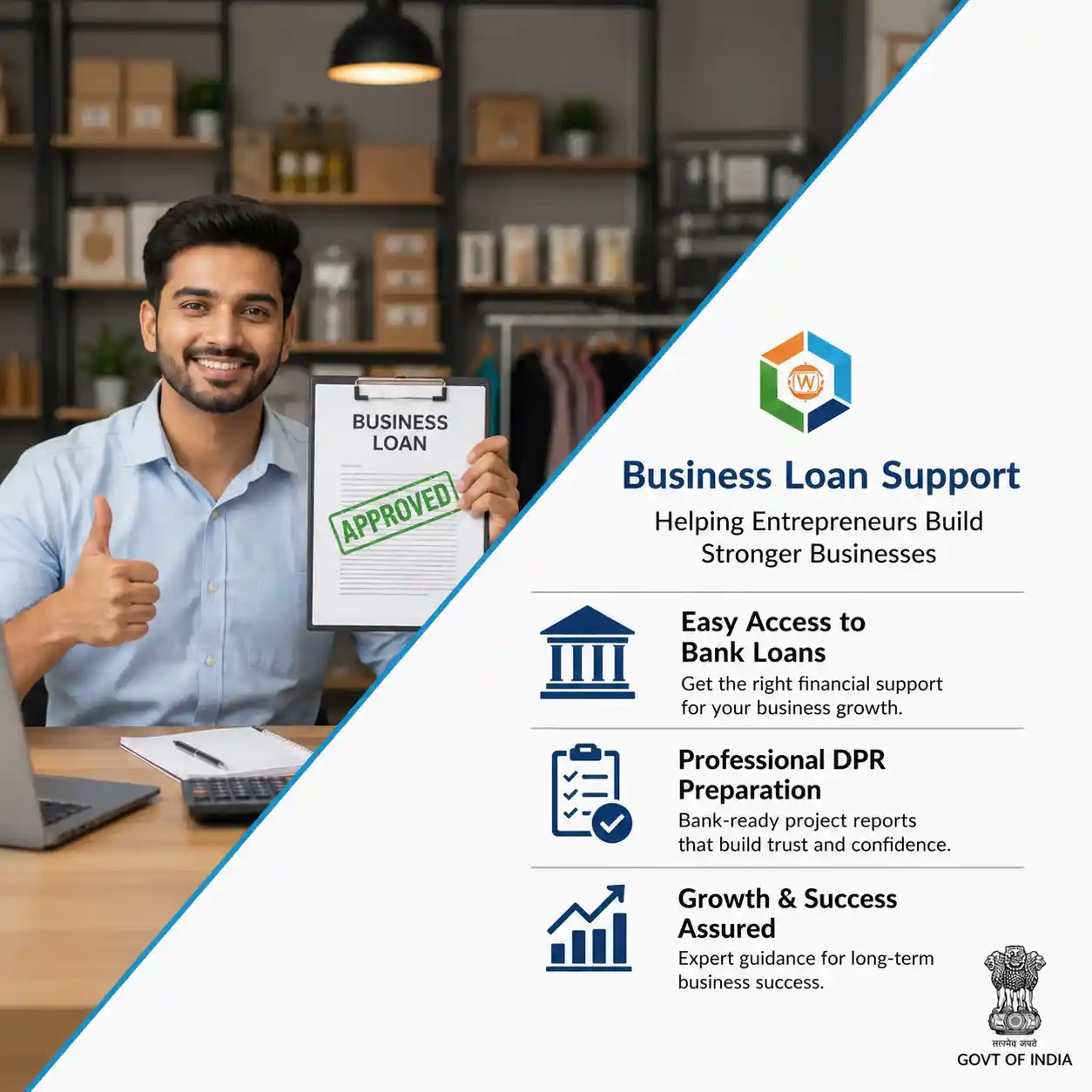
Taking a business loan is one of the most important financial decisions for any entrepreneur. Whether you are starting a new project, expanding an existing business, purchasing machinery, or availing benefits under government subsidy schemes, proper planning before taking a loan is extremely important.
Many borrowers focus only on loan approval and overlook important aspects such as processing charges, interest calculation methods, repayment structure, and long-term financial impact. A wrong financial decision can create unnecessary pressure on the business in the future.
Before applying for a project loan or business loan, it is important to understand how banks evaluate borrowers and how different loan terms can affect your finances. Below are some important points every entrepreneur should know before taking a loan.
Most people focus only on the interest rate while comparing loans. However, the actual cost of borrowing includes several other charges such as:
In many project loans, processing charges alone can be significant depending on the loan amount. Therefore, always ask the bank for a complete breakup of charges before accepting the sanction.
If you have a strong project profile and good financial background, you can also negotiate for lower processing fees.
Before taking a loan, it is important to understand how the bank calculates interest.
Fixed Interest Rate
In a fixed interest loan, the interest rate remains constant throughout the loan tenure. Your EMI usually remains stable even if RBI changes interest rates.
Advantages:
Disadvantages:
We understand your business/ idea, investment plans and funding requirements and other key points
You provide us the required documents and information. We guide you on every document needed
We structure your project in funding point of view and finalize the project outlay and share with you for your feed back.
We prepare the Detailed Project Report (DPR) with all requird sections, projections and annexures
We review the DPR with you, incorporate your feed back and finalize the details ensure the accuracy
We assist in submission of bank loan documents, attend the banker query if any and guide you till the loan sanction
Floating Interest Rate
In floating interest loans, the interest rate changes according to RBI policy rates and the bank’s benchmark lending rate.
Advantages:
Disadvantages:
Many business loans and project loans are sanctioned on floating interest basis. Therefore, borrowers should regularly monitor interest rate changes.
Many borrowers make costly mistakes because they do not understand how interest is calculated.
Flat Interest Method
In this method, interest is calculated on the original loan amount throughout the loan tenure, even though you continue repaying the principal every month.
This can make the actual cost of borrowing much higher than it appears.
Some consumer loans and vehicle loans use this method.
Reducing Balance Method
In this method, interest is calculated only on the outstanding loan balance after each repayment.
As the principal reduces, the interest amount also reduces gradually.
This method is commonly used in:
Even if the interest rate looks slightly higher, reducing balance loans are often more economical in the long run compared to flat rate loans.
Your CIBIL score and banking history play an important role in loan approval.
Banks use your credit history to evaluate:
A healthy credit score can help you:
Before applying for a loan:
Business loans are generally categorized into:
Secured Loans
These loans require collateral security such as:
Advantages:
Unsecured Loans
These loans do not require collateral but generally come with:
Choose the loan structure carefully depending on your business requirement and repayment capacity.
Many borrowers plan to repay loans early after business income improves. However, some banks and NBFCs charge penalties for early closure or prepayment.
Before signing the loan agreement, ask clearly about:
Understanding these conditions in advance can help avoid unnecessary expenses later.
Do not accept the first loan offer immediately.
Different banks may offer variations in:
If your project profile is strong and financially viable, you can negotiate better terms by comparing multiple banks and financial institutions.
However, while comparing loans, do not focus only on low interest rates. Evaluate the complete loan structure carefully.
A professionally prepared Detailed Project Report (DPR) significantly improves your loan proposal.
A good DPR helps the bank understand:
A structured DPR generally includes:
Proper project documentation creates confidence in the banker and improves the quality of the proposal.
Before taking any loan, honestly evaluate whether your business can comfortably handle the EMI and repayment obligations.
Avoid taking loans beyond your repayment capacity simply because you are eligible for higher loan amounts.
Business income may fluctuate due to:
Hence, always maintain a financial buffer for emergencies.
Many entrepreneurs make financial mistakes due to lack of proper guidance during project planning and loan structuring.
Professional guidance can help in:
A properly structured project has better chances of smooth loan processing and approval.
At BankOn, we provide professional assistance for:
We prepare customized bank-ready DPRs based on your project requirement and loan structure.
Taking a business loan is a long-term financial commitment that requires careful planning and informed decision-making.
Understanding loan structures, repayment obligations, interest calculations, and proper project planning can help entrepreneurs avoid unnecessary financial stress and improve their chances of success.
A properly structured project with professional documentation not only improves loan approval chances but also helps in better business planning and execution.
If you require professional assistance for DPR preparation or project loan guidance, feel free to contact BankOn for expert support.
Get expert guidance for project reports, loan and subsidies so you can focus on what you do best-Growing you business.

Need any clarification? Write to us…
Explore expert insights on business loans, DPR preparation, and government schemes designed to help entrepreneurs secure funding and grow with confidence.
© 2026 BANKON SERVICES • ALL RIGHTS RESERVED • PRIVACY POLICY • TERMS AND CONDITIONS • DISCLAIMER