For entrepreneurs planning commercial polyhouse, greenhouse and other protected cultivation projects, this is an important policy development.
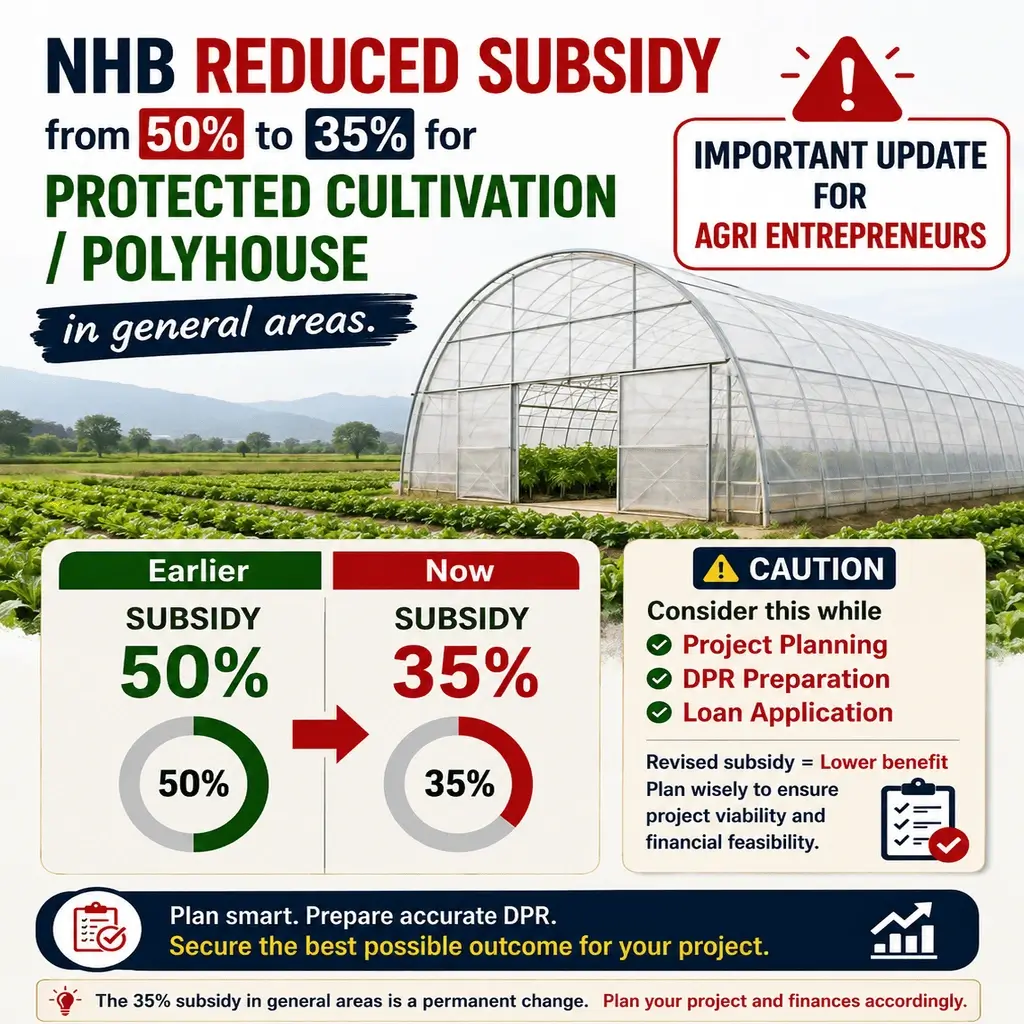
The subsidy component has traditionally played a significant role in making capital-intensive protected cultivation projects financially viable. Under the earlier framework, protected-cover cultivation under NHB was supported through a credit-linked back-ended subsidy of 50% of the eligible project cost, subject to applicable cost norms and limits.
With the revised provision reducing the assistance to 35% in general areas, the financial calculations for new projects need to be reconsidered.
The difference between 50% and 35% may appear to be only 15 percentage points, but for a capital-intensive polyhouse project, the impact can be substantial.
Consider a simplified example.
If the eligible project cost is ₹1 crore:
| Earlier | Revised | |
|---|---|---|
| Subsidy rate | 50% | 35% |
| Indicative subsidy | ₹50 lakh | ₹35 lakh |
| Difference | ₹15 lakh |
This means that, in a simplified illustration, the entrepreneur may have to arrange or finance an additional ₹15 lakh compared with the earlier subsidy structure.
The actual subsidy, of course, depends on the applicable NHB cost norms, eligible components, project structure and other scheme conditions.
The timing of the change makes it particularly significant for new agri entrepreneurs.
Protected cultivation already involves substantial upfront investment in:
At the same time, entrepreneurs are dealing with higher material costs, labour expenses and operating costs.
Therefore, reducing the subsidy support does not merely reduce the amount of government assistance. It can change the overall financial viability of the project.
A project that appeared attractive when calculated with a 50% subsidy may produce a very different return on investment when the subsidy is assumed at 35%.
The biggest impact will be on the capital structure and repayment burden.
A lower subsidy means a larger portion of the project cost has to be supported through:
This can increase the debt requirement and consequently increase the annual debt-servicing burden.
For projects with only moderate operating margins, that additional financial burden can make the difference between a comfortable project and a highly leveraged one.
If the bank finances the project based on the revised structure, the promoter may have to bring in additional margin money.
This is particularly relevant for first-time entrepreneurs who have limited capital available for investment.
If the reduction in subsidy is compensated by additional borrowing, the project may have a higher term-loan obligation.
The project therefore needs to be evaluated not only on the basis of subsidy received, but also on:
Revenue → Operating Cost → EBITDA → Debt Service → Cash Surplus
The question is no longer simply:
“How much subsidy can I get?”
It becomes:
“Does the project remain financially viable after the revised subsidy?”
Not every crop will respond to the same economics.
Crop price, yield, production cycle, market linkage, wastage, labour requirement and selling price can dramatically affect the profitability of a protected cultivation project.
Entrepreneurs may therefore need to be more selective about:
Production assumptions
The reduction in subsidy is undoubtedly negative from the perspective of an entrepreneur planning a new project.
But it does not automatically mean that polyhouse cultivation is no longer viable.
A well-designed project with:
can still be viable.
The key difference is that the project has less room for error.
Earlier, the higher subsidy provided a larger cushion against the initial capital expenditure. With a lower subsidy, the entrepreneur has to be much more careful about project costing and financial projections.
This is where the change has an important implication for project financing.
A DPR should not simply be prepared by taking:
Project Cost – Subsidy = Loan Requirement.
The revised subsidy structure requires the entire project to be examined from a financial perspective.
A proper DPR should evaluate:
Project Cost
↓
Eligible Cost Under Applicable Norms
↓
Expected Subsidy
↓
Promoter Contribution
↓
Term Loan Requirement
↓
Working Capital
↓
Projected Revenue
↓
Operating Expenses
↓
Debt Servicing
↓
Cash Flow & Repayment Capacity
This becomes particularly important when the project is being presented to a bank.
Banks will ultimately be interested in whether the underlying business can generate sufficient cash flow to service the proposed debt, rather than simply whether the project is eligible for a subsidy.
At BankOn Services, we assist entrepreneurs with:
If you are planning polyhouse project, professional planning at the beginning can help avoid delays and improve the overall viability of your investment.
Disclaimer: The information provided here is for general informational purposes only. For the most accurate and up-to-date details on the scheme, including eligibility, application process, and specific benefits, please refer to the official scheme website: https://nhb.gov.in/
Get expert guidance for project reports, loan and subsidies so you can focus on what you do best-Growing you business.

Need any clarification? Write to us…
Explore expert insights on business loans, DPR preparation, and government schemes designed to help entrepreneurs secure funding and grow with confidence.
© 2026 BANKON SERVICES • ALL RIGHTS RESERVED • PRIVACY POLICY • TERMS AND CONDITIONS • DISCLAIMER