Goat farming is increasingly being considered as a commercial business opportunity rather than just a traditional agricultural activity. Entrepreneurs planning a scientific and organised goat farming project often look for government support to reduce the financial burden.
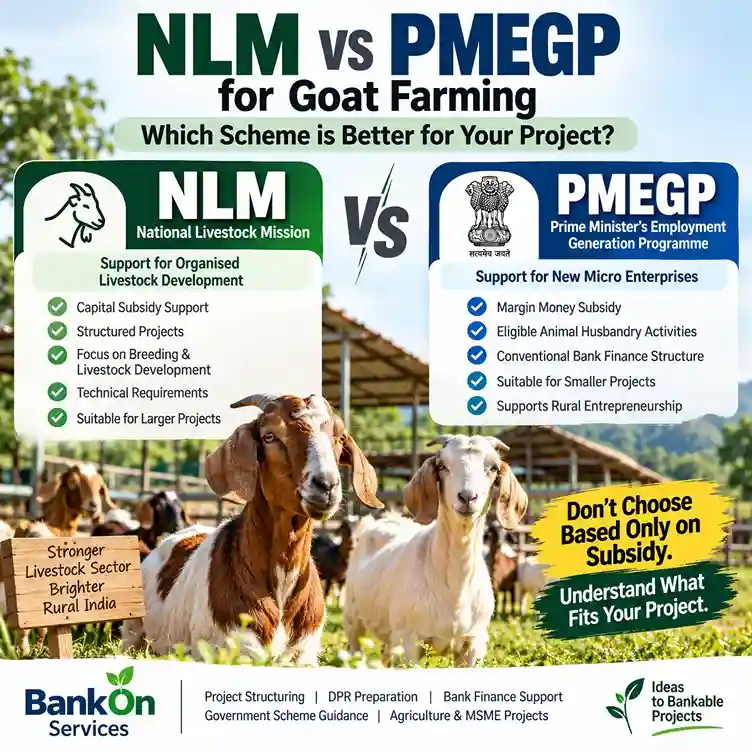
Two schemes that frequently come into discussion are the National Livestock Mission (NLM) and the Prime Minister’s Employment Generation Programme (PMEGP).
At first glance, the decision may appear simple:
NLM offers higher subsidy, while PMEGP offers margin money subsidy.
But selecting a scheme based only on the subsidy percentage can be a mistake.
The right choice depends on the project scale, type of goat farming model, eligibility, investment structure, documentation requirements and implementation process.
Under the Entrepreneurship Development component of NLM, support is available for eligible sheep and goat breeding enterprises. The scheme is designed to encourage organised entrepreneurship and scientific livestock development.
Official NLM materials specify minimum-scale requirements for eligible sheep/goat breeding units and provide for up to 50% capital subsidy, subject to applicable guidelines and limits. The remaining project cost has to be arranged through bank finance or other eligible sources. (Dahd Monitor)
NLM is therefore generally more suited to entrepreneurs planning a larger, structured and technically organised breeding project.
PMEGP is a credit-linked margin money subsidy programme intended to support new micro enterprises.
The current PMEGP framework includes eligible animal-husbandry activities, subject to scheme conditions and the prescribed activity criteria. Specific KVIC guidance classifies animal-husbandry units under the service sector for determining the applicable project-cost ceiling for subsidy purposes. (KVI Online)
For a goat farming entrepreneur, PMEGP may therefore be considered depending on the exact activity and project structure.
Factor | NLM | PMEGP |
Primary focus | Organised livestock entrepreneurship | New micro enterprises |
Goat farming approach | Breeding and organised livestock development | Eligible animal-husbandry enterprise activities |
Subsidy pattern | Up to 50% capital subsidy, subject to guidelines | Margin money subsidy based on applicable category/location |
Project scale | Generally structured around prescribed minimum scale | More suitable for eligible micro-enterprise scale projects |
Technical requirements | Higher emphasis on scientific breeding and project requirements | Comparatively conventional micro-enterprise financing approach |
Documentation | Can be more detailed and process-intensive | Depends on project, bank and implementing agency requirements |
Project monitoring | Structured implementation requirements may apply | Bank finance and scheme implementation process |
Best suited for | Serious, organised livestock entrepreneurs | Eligible smaller-scale/new enterprise promoters |
The above comparison is indicative. Actual eligibility depends on the prevailing scheme guidelines and the specific project proposal.
Not necessarily.
This is where many entrepreneurs make a mistake.
Suppose an entrepreneur sees:
NLM – Up to 50% subsidy
Naturally, the first reaction may be:
“Why should I consider any other scheme?”
But a higher subsidy percentage should not be the only factor in project planning.
A larger livestock project requires:
If an entrepreneur is not genuinely prepared to operate a larger organised goat breeding enterprise, selecting a scheme simply because it offers a higher subsidy can create problems later.
The project should fit the entrepreneur first. The scheme should fit the project second.
NLM may be worth exploring when the entrepreneur is planning a serious and organised goat breeding enterprise and is prepared to meet the applicable scale and technical requirements.
It may be particularly relevant when:
NLM is not simply a “high subsidy scheme.” It is designed around developing organised livestock entrepreneurship.
PMEGP may be worth examining where the proposed activity fits within the scheme’s current eligibility framework and the entrepreneur is planning a new eligible micro-enterprise.
Depending on the project structure, PMEGP may be more relevant for entrepreneurs who:
However, eligibility should not be assumed simply because the project is called “goat farming.” The exact activity, investment structure and prevailing scheme provisions should be checked before preparing the application. (KVI Online)
Before comparing subsidy percentages, an entrepreneur should answer a few basic questions.
A small farm and a large organised breeding enterprise should not necessarily be structured in the same way.
Is the focus on:
The business model matters.
Land availability alone is not enough. The project needs appropriate infrastructure, sheds, feeding arrangements, water facilities and operational planning.
A DPR should clearly establish:
This is one of the most important questions.
Subsidy may reduce part of the financial burden, but the project still needs to generate sufficient cash flow to sustain operations and meet loan repayment obligations.
Many project discussions begin like this:
“Which scheme gives the highest subsidy for goat farming?”
A better question is:
“What is the right business model and financial structure for my goat farming project?”
Once the project is properly conceptualised, it becomes easier to evaluate:
This approach prevents the entrepreneur from redesigning an entire business just to chase a subsidy.
A goat farming project should not be prepared by simply multiplying:
Number of goats × Cost per goat
A professional project assessment should consider the complete business model.
This may include:
An unrealistic DPR may look impressive on paper but create difficulties during bank appraisal or project implementation.
There is no universal answer.
NLM may be attractive for:
Larger and organised goat breeding enterprises that can meet the scheme’s prescribed requirements and are prepared for a structured implementation process.
PMEGP may be relevant for:
Eligible new micro-enterprise projects where the activity and promoter meet the prevailing PMEGP guidelines.
The best scheme is not necessarily the one offering the highest subsidy.
The best scheme is the one that fits the project’s scale, business model, eligibility and financing structure.
Government subsidy can support a viable project, but subsidy alone cannot make an unviable business successful.
Before investing in a goat farming enterprise, entrepreneurs should first focus on:
Only after these factors are understood should the entrepreneur decide whether NLM, PMEGP or another financing route is appropriate.
BankOn Services assists entrepreneurs in the planning and structuring of Agriculture, MSME and Food Processing projects, including:
Planning a serious goat farming or livestock project? A properly structured project should come before the loan or subsidy application.
Disclaimer: The information provided here is for general informational purposes only. For the most accurate and up-to-date details on the scheme, including eligibility, application process, and specific benefits, please refer to the official scheme websites
Get expert guidance for project reports, loan and subsidies so you can focus on what you do best-Growing you business.

Need any clarification? Write to us…
Explore expert insights on business loans, DPR preparation, and government schemes designed to help entrepreneurs secure funding and grow with confidence.
© 2026 BANKON SERVICES • ALL RIGHTS RESERVED • PRIVACY POLICY • TERMS AND CONDITIONS • DISCLAIMER